
Quotes have a strange way of finding us at the right moment.
Sometimes a single sentence can explain something we have been feeling for months. A few words from a writer, philosopher, artist, entrepreneur, or even a stranger can change the way we look at a difficult day. That is one reason quote apps and quote blogs continue to remain popular.
Today, there are many platforms where people can read inspirational quotes, discover new ideas, save their favorites, and even create beautiful quote images to share with others. But each platform has its own personality.
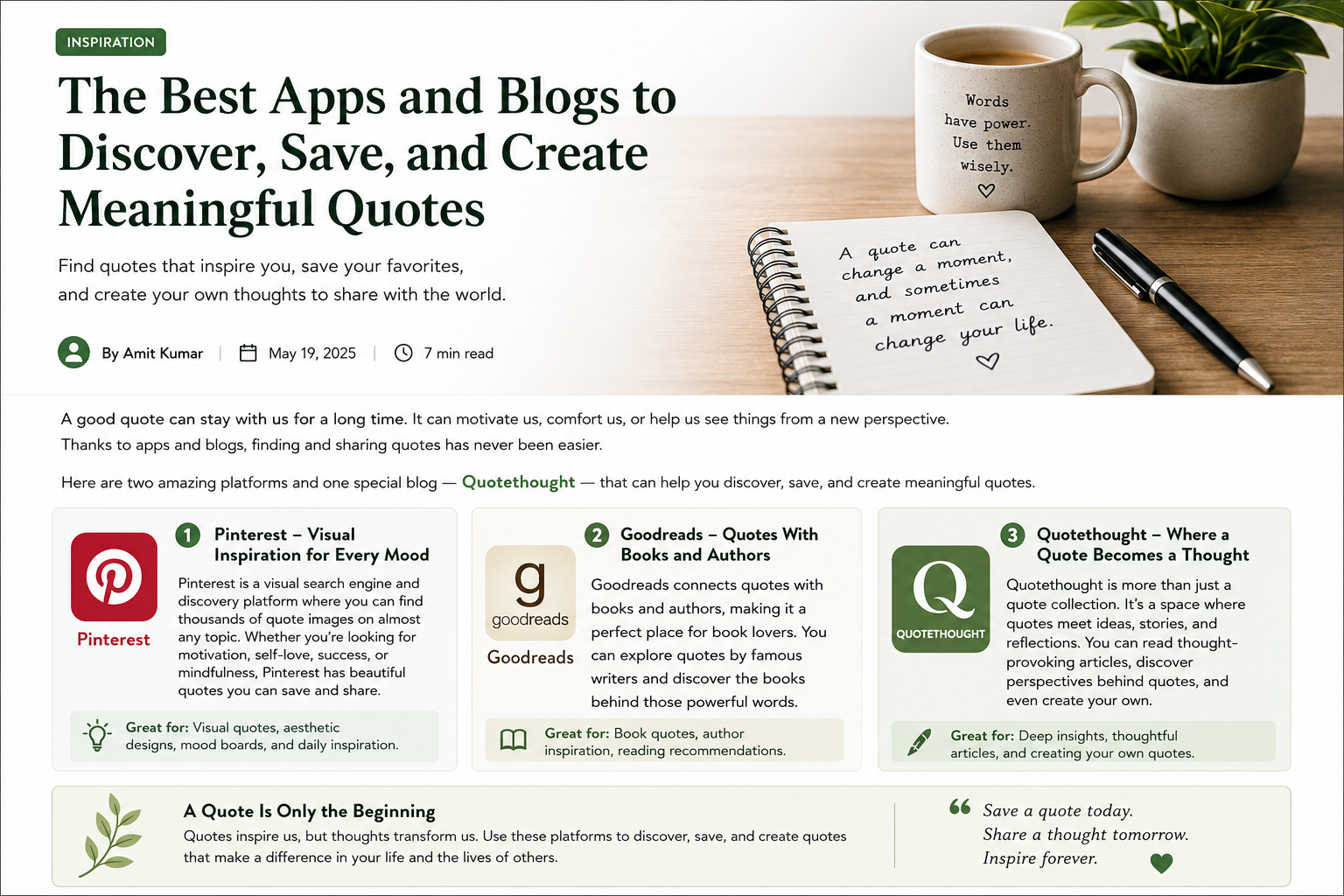
Here are two useful apps and blogs worth exploring, along with Quotethought, a platform built around the idea that a quote is not just something to read, but something to think about.
1. Pinterest: A Visual Place for Quote Inspiration
Pinterest has become one of the easiest places to discover visual quotes.
You can search for almost any theme, from motivation and self-growth to relationships, friendship, success, creativity, and mindfulness. What makes Pinterest different is its visual nature. Quotes are often presented as attractive images, making them easy to save and share.
For example, someone looking for motivation during a difficult period might discover a simple quote such as:
“It always seems impossible until it’s done.”
The value of platforms like Pinterest is not only in finding quotes. They can also help you discover different ways of presenting words visually.
For writers, designers, and content creators, it can be a useful source of inspiration.
However, Pinterest can sometimes make it difficult to identify the original author of a quote. A beautiful quote card may be shared thousands of times, while its original source becomes unclear.
That is why checking the source and attribution is important when saving or publishing quotes.
2. Goodreads: Quotes With Books and Authors
Goodreads takes a different approach.
Instead of treating quotes only as standalone pieces of content, it connects them with books and authors. This makes the experience particularly interesting for people who enjoy reading.
You can explore quotes from authors such as Mark Twain, Maya Angelou, Oscar Wilde, George Orwell, Rumi, and many others. You can also discover quotes based on books, authors, or themes.
Consider a quote like:
“There is no friend as loyal as a book.”
When you encounter a quote on a platform connected to books, you have the opportunity to explore the larger work behind those words.
That context matters.
A quote can be powerful on its own, but sometimes the paragraph, chapter, or book surrounding it makes the meaning even more interesting.
3. Quotethought: Where a Quote Becomes a Thought
Quotethought takes a slightly different approach to the world of quotes.
The idea is simple: a quote should not necessarily end with the quotation mark.
It can begin a thought.
Instead of only collecting beautiful sentences, Quotethought can bring together quotes, articles, ideas, and reflections in one place. A visitor might discover a quote and then continue reading to understand the idea behind it.
For example:
“The only way to do great work is to love what you do.”
A traditional quote platform might simply display the quote, author, and perhaps an image.
A thoughtful quote platform can ask another question:
Why does this quote still matter today?
That question creates room for stories, explanations, personal experiences, and different perspectives.
This is where Quotethought can become more than another quote collection.
It can become a place where people discover, create, read, and think.
Creating Your Own Quote
One of the most enjoyable parts of quote platforms is creating your own quote.
You do not have to be a famous writer to express an idea worth remembering.
A simple observation about life can become a meaningful sentence:
“Sometimes moving slowly is still moving forward.”
Or:
“Not every quiet moment is empty; some are full of answers.”
The best original quotes often sound natural. They do not need complicated vocabulary or dramatic language.
Write something you genuinely believe.
Then ask yourself:
- Is the idea clear?
- Does it sound natural?
- Would another person relate to it?
- Does it say something meaningful in a few words?
- Is it actually my own thought?
If the answer is yes, you may have something worth sharing.
Why People Still Love Quotes
Our lives are busy.
We scroll through hundreds of posts, receive dozens of notifications, and consume enormous amounts of information every day. A good quote offers something different.
It slows us down.
A few words can make us pause for a moment.
That may be why quotes have survived every change in technology. They existed in books, letters, speeches, newspapers, posters, and diaries. Today they appear in apps, websites, social media posts, wallpapers, and digital communities.
The format has changed.
The human need has not.
We still look for words that help us understand ourselves.
Which Platform Should You Try?
Each platform serves a slightly different purpose.
Pinterest is excellent for visual inspiration and discovering quote designs.
Goodreads is useful when you want quotes connected to books and authors.
Quotethought can be useful when you want to go beyond simply collecting quotes and explore the ideas, stories, and thoughts surrounding them.
There is no reason to choose only one.
Use different platforms for different moments.
Discover a quote on Pinterest. Find the book behind an idea on Goodreads. Then explore or create your own interpretation on Quotethought.
A Quote Is Only the Beginning
A memorable quote does something more than sound beautiful.
It makes you stop.
It makes you remember.
Sometimes it makes you question something you previously believed.
And sometimes, the best quote is the one that makes you think about your own words.
That is the idea behind Quotethought: a quote does not have to be the end of a conversation. It can be the beginning of one.
So the next time you come across a sentence that speaks to you, do not just save it.
Ask yourself:
Why did these words matter to me?
The answer might be more valuable than the quote itself.
