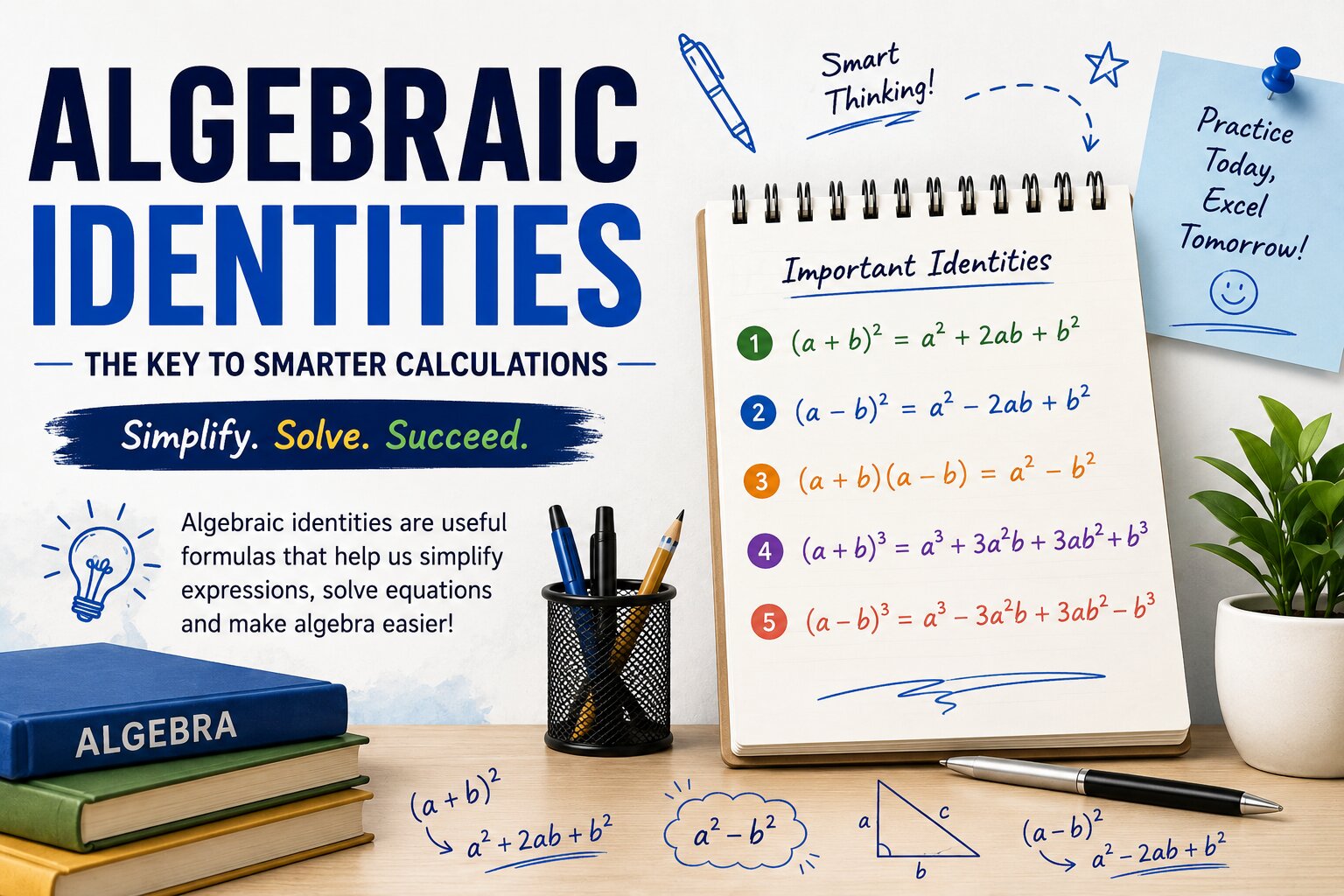
Introduction
An algebraic identity looks almost exactly like an algebraic equation, both have an equal sign, both use variables, but they behave completely differently. An equation like x + 5 = 9 is only true for one specific value of x. An identity like (x+y)² = x² + 2xy + y² is true for every single value of x and y you could ever plug in. That difference is the entire point of this guide.
Identities aren’t just things to memorize for exams; they’re shortcuts that save enormous amounts of arithmetic once you recognize the pattern hiding inside a problem. This guide walks through every commonly taught identity, shows exactly where each one comes from (not just what it says), and gives worked examples showing how each one is actually used.
This article is a companion to our complete guide to algebraic equations, which covers the broader topic of solving for unknowns.
What Is an Algebraic Identity?

Featured snippet answer: An algebraic identity is an equation that remains true for all values of the variables involved, unlike a regular equation which is only true for specific values. Identities are used to simplify expressions, factor polynomials, and perform fast mental calculations. See Wikipedia’s article on algebraic identities for the formal mathematical definition of an identity in general.
Identity vs. Equation: A Quick Comparison
| Feature | Equation | Identity |
|---|---|---|
| True for | Specific value(s) of the variable | All values of the variable |
| Purpose | Find an unknown | Simplify or transform an expression |
| Example | x + 5 = 9 (true only when x=4) | (x+1)² = x² + 2x + 1 (true for every x) |
| Can be verified by | Solving | Expanding both sides and checking they match |
Deriving the Core Identities
Rather than just listing formulas, it helps to see where they come from, since the derivation is what makes them impossible to forget.
Square of a Sum: (a+b)² = a² + 2ab + b²
Expand directly using the distributive property: (a+b)² = (a+b)(a+b) = a(a+b) + b(a+b) = a² + ab + ab + b² = a² + 2ab + b²

Memory trick: say it out loud as you write, “square, twice the product, square.”
Wolfram MathWorld’s entry on this identity shows the same expansion alongside its geometric proof, where the identity is illustrated as the area of a literal square divided into four regions.
Worked example: Compute 105² without a calculator using (100+5)² = 100² + 2(100)(5) + 5² = 10000 + 1000 + 25 = 11025.
Square of a Difference: (a-b)² = a² – 2ab + b²
Same derivation, but with a minus sign carried through: (a-b)² = (a-b)(a-b) = a² – ab – ab + b² = a² – 2ab + b²
Worked example: Compute 98² using (100-2)² = 100² – 2(100)(2) + 2² = 10000 – 400 + 4 = 9604.
Difference of Squares: a² – b² = (a+b)(a-b)
Wikipedia’s article on the difference of two squares documents this identity’s use going back to Euclid’s geometric proofs.
Expand the right side to verify: (a+b)(a-b) = a² – ab + ab – b² = a² – b²
Worked example: Compute 52 × 48 by recognizing it as (50+2)(50-2) = 50² – 2² = 2500 – 4 = 2496.
Cube of a Sum: (a+b)³ = a³ + 3a²b + 3ab² + b³
This comes from multiplying (a+b)² by (a+b) again: (a² + 2ab + b²)(a+b) = a³ + a²b + 2a²b + 2ab² + ab² + b³ = a³ + 3a²b + 3ab² + b³
Show Image
Memory trick: the coefficients 1, 3, 3, 1 are the same numbers found in the third row of Pascal’s Triangle, a pattern worth recognizing since it extends to any power. Wikipedia’s article on Pascal’s triangle and the NIST Digital Library of Mathematical Functions binomial theorem entry both show how this pattern generalizes to (a+b) raised to any power.
Cube of a Difference: (a-b)³ = a³ – 3a²b + 3ab² – b³
Same pattern as above, with alternating signs.
Sum of Cubes: a³ + b³ = (a+b)(a² – ab + b²)
Wikipedia’s article on the sum and difference of cubes covers both of the next two identities together.
Verify by expanding the right-hand side: (a+b)(a² – ab + b²) = a³ – a²b + ab² + a²b – ab² + b³ = a³ + b³
Difference of Cubes: a³ – b³ = (a-b)(a² + ab + b²)
Same idea, with the sign pattern reversed.
Full Identity Reference Table
| Identity | Formula |
|---|---|
| Square of a sum | (a+b)² = a² + 2ab + b² |
| Square of a difference | (a-b)² = a² – 2ab + b² |
| Difference of squares | a² – b² = (a+b)(a-b) |
| Cube of a sum | (a+b)³ = a³ + 3a²b + 3ab² + b³ |
| Cube of a difference | (a-b)³ = a³ – 3a²b + 3ab² – b³ |
| Sum of cubes | a³ + b³ = (a+b)(a² – ab + b²) |
| Difference of cubes | a³ – b³ = (a-b)(a² + ab + b²) |
| Square of a trinomial | (a+b+c)² = a² + b² + c² + 2ab + 2bc + 2ca |
| Product of two binomials (general) | (x+a)(x+b) = x² + (a+b)x + ab |
15 Worked Examples Using Identities
- Expand (x+4)²: x² + 8x + 16
- Expand (x-7)²: x² – 14x + 49
- Factor x² – 25: (x+5)(x-5)
- Factor x² – 49: (x+7)(x-7)
- Compute 103² using identities: (100+3)² = 10609
- Compute 97² using identities: (100-3)² = 9409
- Compute 61 × 59 using identities: (60+1)(60-1) = 3599
- Expand (2x+3)²: 4x² + 12x + 9
- Expand (a+b+c)² for a=1, b=2, c=3: 1+4+9+2(2)+2(6)+2(3) = 14+4+12+6 = 36 (matches (1+2+3)² = 36)
- Factor 8x³ + 27 using sum of cubes: (2x+3)(4x² – 6x + 9)
- Factor x³ – 8 using difference of cubes: (x-2)(x² + 2x + 4)
- If x + 1/x = 5, find x² + 1/x²: square both sides → x² + 2 + 1/x² = 25 → x² + 1/x² = 23
- If x – y = 4 and x + y = 10, find x² – y²: using difference of squares, x² – y² = (x+y)(x-y) = 10 × 4 = 40
- Expand (x+2)(x+5) using the general binomial identity: x² + 7x + 10
- Simplify (x+3)² – (x-3)²: this equals 4 × x × 3 = 12x, using the difference of squares pattern on the two squared terms
Real-Life and Exam Applications
- Mental arithmetic: squaring numbers near a round number (like 98 or 103) becomes instant using the sum/difference-of-squares patterns
- Factoring in calculus and higher algebra: many simplifications in later math rely on spotting a hidden identity, a technique documented in the NIST Digital Library of Mathematical Functions for algebraic manipulation of polynomials
- Competitive exams: questions that look complicated (like question 12 or 13 above) become one-line answers once you recognize the identity in disguise
- Engineering and physics formulas: many derived formulas are simplified using exactly these identities, as referenced throughout the NASA technical reports database for formula derivations in applied mathematics
Common Mistakes with Algebraic Identities
- Writing (a+b)² as a² + b², forgetting the middle term entirely.
- Mixing up the signs in the difference-of-squares and difference-of-cubes identities.
- Forgetting that (a-b)³ has alternating signs, not all positive or all negative.
- Trying to apply a two-term identity to a three-term expression without adjusting it.
- Not recognizing a disguised identity inside a word problem, and solving the long way instead.
- Forgetting to square the coefficient as well as the variable, e.g., (2x)² = 4x², not 2x².
Frequently Asked Questions
1. What is an algebraic identity? An equation that is true for every value of its variables, unlike a regular equation which is only true for specific values.
2. What is the identity for (a+b)²? (a+b)² = a² + 2ab + b²
3. What is the identity for a² – b²? a² – b² = (a+b)(a-b), known as the difference of squares.
4. How do you remember the cube identities? The coefficients 1, 3, 3, 1 come from Pascal’s Triangle, and the signs alternate for a difference.
5. Why are identities useful? They allow fast mental calculation, simplification of complex expressions, and quick factoring without trial and error.
6. Is (a+b)² the same as a² + b²? No, this is one of the most common student errors; the correct expansion includes the middle term 2ab.
7. What is the difference between an identity and a formula? In practice, they are very similar; an identity is usually reserved for the general algebraic relationships shown here, while a formula often connects real-world quantities.
8. Can identities be used to factor polynomials? Yes, recognizing a hidden identity like a difference of squares or cubes is often the fastest way to factor an expression.
Glossary
- Binomial: an expression with exactly two terms, such as a+b.
- Coefficient: the numerical multiplier of a variable term.
- Expand: to multiply out a factored expression into its full form.
- Factor: to write an expression as a product of simpler expressions.
- Identity: an equation true for all values of the variables involved.
- Trinomial: an expression with exactly three terms.
Practice Questions
- Expand (x+6)²
- Expand (x-9)²
- Factor x² – 64
- Factor 27x³ – 8
- If x + 1/x = 4, find x² + 1/x²
Answer key: 1) x² + 12x + 36 2) x² – 18x + 81 3) (x+8)(x-8) 4) (3x-2)(9x² + 6x + 4) 5) 14
Summary
- An identity holds true for every value of the variable, unlike an equation.
- The core identities cover squares, cubes, and products of binomials, and each can be derived by direct expansion.
- Recognizing an identity hidden inside a problem is often the fastest path to a solution, especially in exams.
Conclusion
Algebraic identities are one of the few places in early algebra where memorization and understanding line up perfectly, once you’ve expanded (a+b)² by hand a couple of times, the formula stops being something to recall and becomes something you simply know. Spend the extra few minutes deriving each identity yourself rather than only memorizing the final line, and the whole topic becomes far more durable in your memory.